

Hotline:
Hotline:
联系人:CHINA SUPREME PEPTIDE
电 话:+852 5335 7470
地 址:Building C3, Jiangsu Life Science and Technology Innovation Park, No.9 Weidi Road, Xianlin University City, Xianlin Street, Qixia District, Nanjing City, Jiangsu Province, China
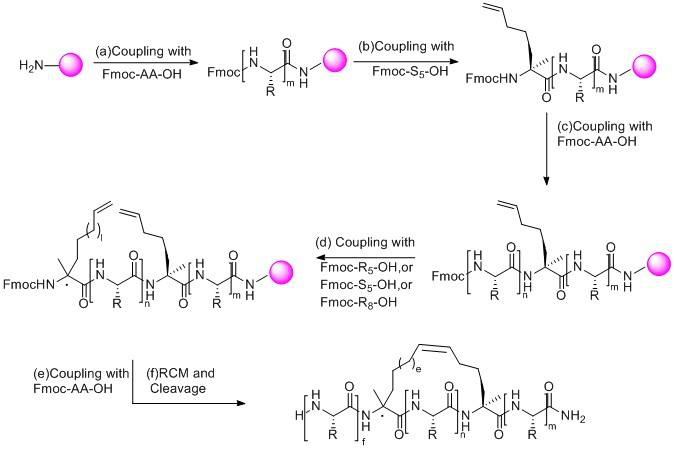
Generally speaking, the biological activity and pharmacological effects of peptide macromolecules are achieved through their secondary and tertiary structures. Simple linear structured peptides are greatly limited in their ability to exert biological activity due to their relatively stable conformation. In response to the above issues, peptide chemists have designed Stapled Peptides, which works by stabilizing the conformation of a specific fragment sequence in the peptide through carbon carbon double bonds to meet specific research needs. Stapled Peptides generally use S5 and R8, separated by 3 amino acids, to form carbon carbon double bonds through olefin metathesis reactions. Peptide based organisms can also develop other special amino acids with similar side chain containing olefin structures to form other similar derivatives.
The difference between the synthesis of stapled peptides and ordinary peptide synthesis lies in the introduction of two non natural amino acids containing alpha methyl and alpha vinyl groups during the solid-phase synthesis of peptide chains. Then, an olefin metathesis reaction occurs between the two non natural amino acids to form a stable all carbon scaffold with an alpha helical conformation, leading to the synthesis of stapled peptides. The difference between the synthesis of stapled peptides and ordinary peptides lies in the introduction of two non natural amino acids containing α - methyl and α - vinyl groups during the solid-phase synthesis of peptide chains. Then, an olefin metathesis reaction occurs between the two non natural amino acids to form a stable all carbon scaffold with an α - helical structure conformation, leading to the synthesis of stapled peptides.
Hotline